

Bits & Pieces #6
Writing like a bison.

I rarely know where I’m going when I sit down to write.
Occasionally I have a jumping off point - an image, a question, a vague conception of a scene - but sometimes I don’t even have that. And even if I do, getting from word to sentence to paragraph to page to completed piece is still painful and slow.
I used to imagine this process as if I were an Indiana Jones type hacking through rainforest undergrowth with a machete, but over the years that image has stopped feeling right - it’s too violent, too brutal. It positions me, the writer, as an individualistic explorer, destroying an intact and healthy and complex ecosystem in order to forge my own path. As if clearcutting my way through a first draft could end in beauty. As if the more-than-human kin around me have nothing to offer my art but obstacle.
Still, I struggled to reframe this image each time I sat down at my computer. If I closed my eyes, I saw a tangle of vines and ferns and trees and bushes, felt my ankles sinking into mud. The machete tucked into my waistband comforted me - I can always just cut everything down and push through. But the kind of writing that came from hacking and slashing and burning never felt good. I saw a point ahead I thought I needed to reach and wrote myself a straight line, but when I turned around and looked at the destruction I had wrought I would be dissatisfied. Even though there were moments of peace, when words and scenes would flow with a lazy ease, they felt like inimitable flukes.
Then, I read a children’s book about bison.
This book had been sitting on my son’s bookshelf for months, getting skipped over in favor of less wordy reads or flashier fiction. But one rainy day last month, he added it to the stack of books he wanted to read together. And suddenly I had my new image.
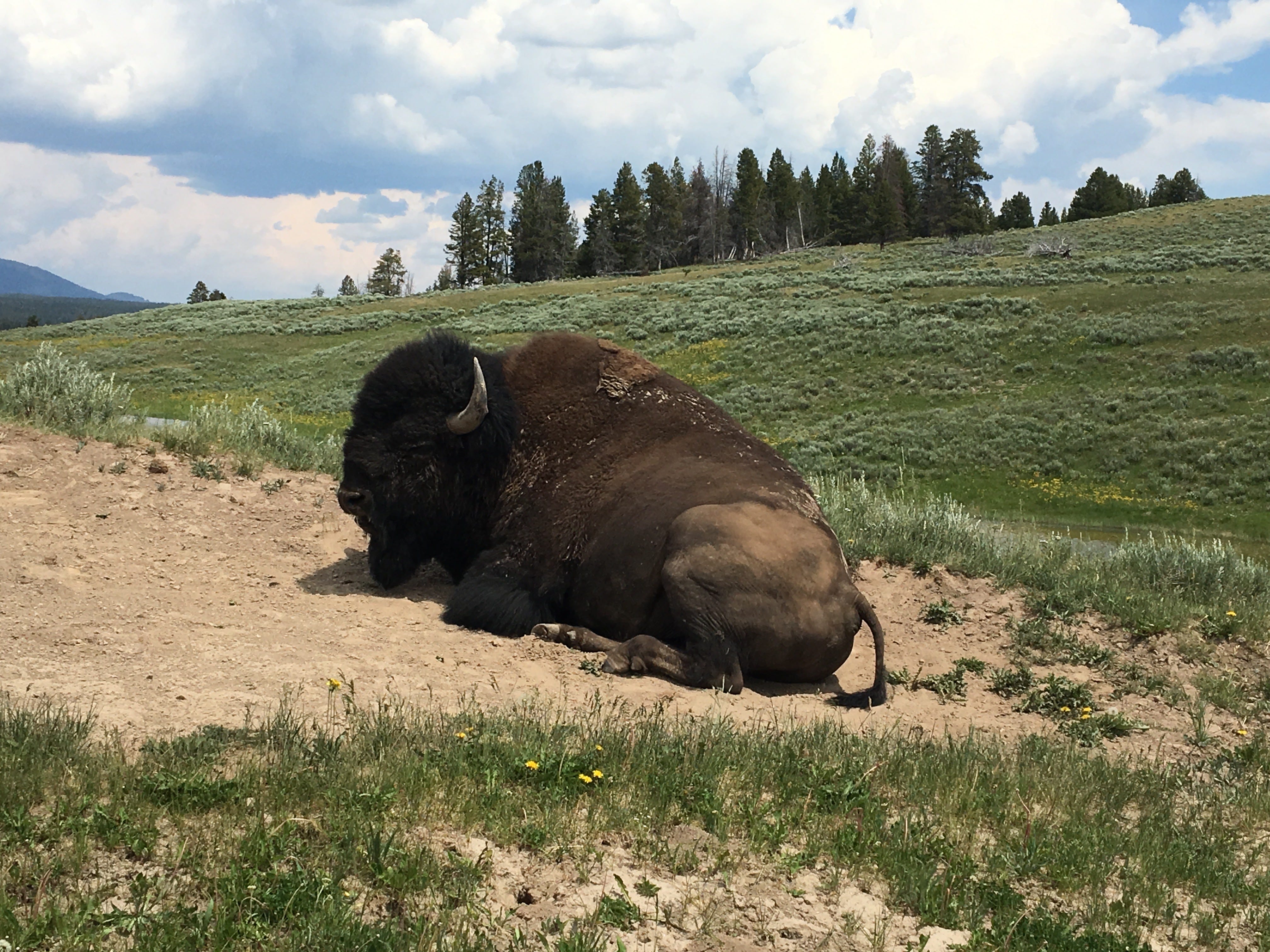
I haven’t thought about bison much since the summer my wife and I visited my best friend in Yellowstone National Park. Then, they were just these powerful, lumbering creatures that seemed to show up in random and odd spots; once, we turned a corner and one was sleeping across the path, forcing a detour. I’d never thought about bison as helpful teachers in my writing practices, instead drawing inspiration from plants and rivers and trees and the moon - from the visible images and structures I could mimic. I saw nature as inspiring the end product of my work, not the process.
But then I learned that -
During their travels, bison don’t follow a pattern… Bison just wander. Sometimes they follow the scent of fresh grass. Sometimes they go where they found good food once before. And sometimes they keep moving until they happen to find a new source of food.1
And -
When bison find an area with fresh grass, they stay for a few days… If the weather is very hot, bison graze during the cooler times at dawn and dusk, and sometimes even at night. If the weather is not hot, they might graze through the afternoon as well. Once or twice a day they go to the nearest stream or pond to take a long drink. Then they return to the grazing area.
And -
A herd could be just about anywhere at any season. Even the [Blackfoot, Lakota, Navajo and Paiute], who knew bison well and depended on them for almost everything, rarely knew exactly where they would be.
There was something so affirming about seeing my natural writing process - the one I was always trying to standardize and shape and force - reflected in the ways of the bison.
Now, I’m trying to embrace writing like a bison.
Instead of forcing a plan for each writing session, I allow myself to wander through my imagination, following a different thread each time - an image, a song, a paragraph I wrote the day before.2 I seek out different sources of story.
Instead of disciplining myself to write at exactly the same time each day, I respond to the season, the weather. I build breaks into my work, to nourish myself before returning to the page; I ignore the clock and word counter.
I still often find myself sitting down to write and not knowing where I’ll end up in a few hours. I still don’t always know the answer. I still don’t always know what I want to say or how I want to say it. But instead of frustration and shame being my motivators, instead of knowing being the barometer for success, I’m guided by patience, trust, and humility. I might turn a corner and find a bison in my path - and if I’m willing to follow her lead, the possibilities are endless.
Another habit of bison that feels metaphorically rich is that they are often drawn to areas that have recently experienced wildfire, because of the fresh grasses that often spring up in burned areas.
It feels important to mention that just because this is a natural rhythm doesn’t mean it’s easy or that it always leads to success. Too often, we raise our more-than-human relatives onto high pedestals and we idealize a “natural” way of life, which only serves to separate us more.
So good! I love that the bison have offered you this sweet reminder or permission to let yourself wander, find fresh nourishment, rest when you need to, revisit good spots - yes to this big mammal guide!
I love this idea of allowing your writing practice to follow the way of the bison. I think so many of us are still trying to force ourselves into a routine closer to a computer program than anything resembling natural - this is such a beautiful way to give yourself flexibility and let your creativity speak when and how it’s ready.